| Sign In | Join Free | My lightneasy.org |
|
| Sign In | Join Free | My lightneasy.org |
|
| Categories | Decanter Centrifuge |
|---|---|
| Wear Protection: | TC / Ceramic / Hardfacing Optional |
| Control System: | PLC Automatic Control |
| Operation: | Continuous Automatic |
| Brand Name: | Peony |
| Model Number: | PDC |
| Certification: | ISO |
| Place of Origin: | China |
| MOQ: | 1 set |
| Price: | USD20500-92000 |
| Payment Terms: | TT,.LC,Western Union |
| Supply Ability: | 80 sets per month |
| Delivery Time: | 60-75 days after down payment |
| Packaging Details: | Standard wooden case |
| Solids Discharge: | Continuous Scroll Discharge |
| Separation Type: | 2-Phase Solid-Liquid Separation |
| MOC: | SS304 / SS316L / Duplex Optional |
| Flocculant Dosing: | Optional |
| Drive System: | Dual Motor with VFD |
| Application: | Phosphate Slurry Dewatering |
| Product Name: | Phosphate Slurry Decanter Centrifuge |
| Company Info. |
| ZHANGJIAGANG CITY PEONY MACHINERY CO.,LTD |
| Verified Supplier |
| View Contact Details |
| Product List |
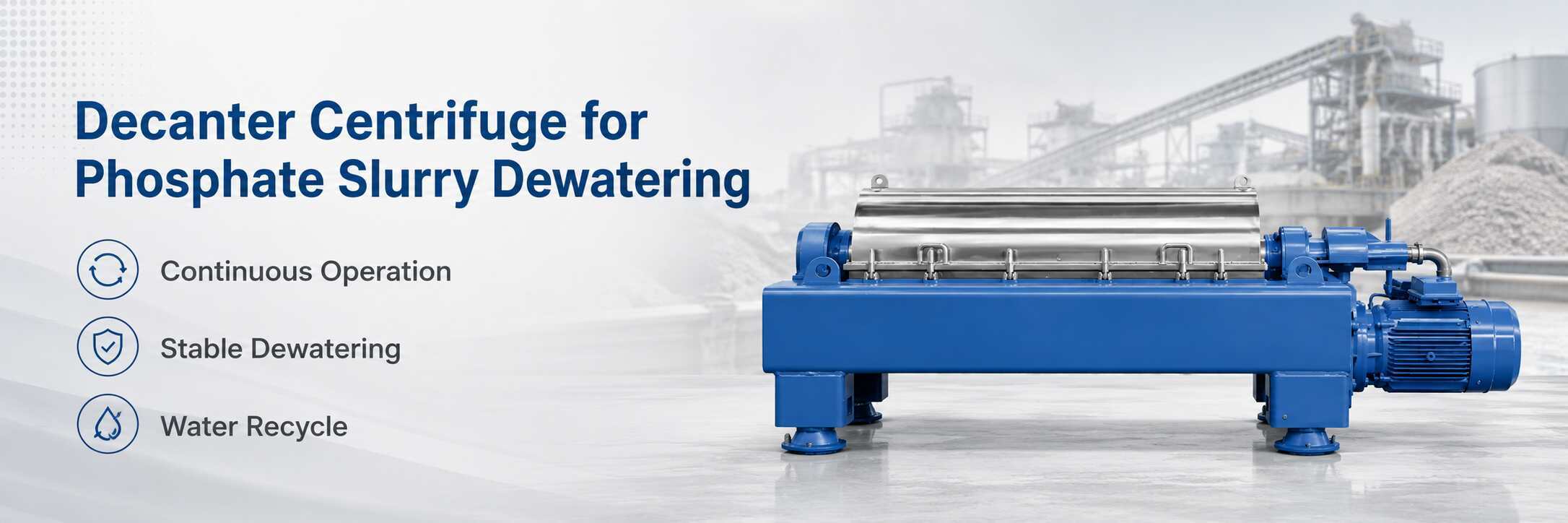
The Decanter Centrifuge for Phosphate Slurry Dewatering is designed for continuous solid-liquid separation, phosphate solids recovery, slurry thickening, and process-water clarification.
It is suitable for phosphate rock washing, beneficiation slurry, fertilizer-process slurry, phosphate-containing wastewater, and mineral fines recovery. The centrifuge separates phosphate solids from the liquid phase continuously. Thickened phosphate solids can be sent to a filter press, dryer, storage tank, granulation section, or further processing stage. Clarified liquid can be reused in washing, grinding, slurry preparation, or wastewater treatment.
| Process Requirement | Decanter Centrifuge Solution |
|---|---|
| Continuous slurry treatment | Continuous feed and solids discharge |
| Fine phosphate recovery | High centrifugal separation force |
| Variable slurry condition | Adjustable bowl speed and differential speed |
| Abrasive mineral particles | Wear-resistant scroll and discharge protection |
| Water recycle | Clarified liquid for reuse or further treatment |
| Lower downstream load | Thickened slurry before filtration or drying |
| Automatic operation | PLC-controlled continuous running |
Peony provides continuous solid-liquid separation for phosphate slurry thickening, solids recovery, and process-water recycle.
Phosphate Washing / Grinding / Classification → Slurry Tank → Optional Flocculant Dosing → Decanter Centrifuge → Thickened Phosphate Solids → Filter Press / Dryer / Storage
Clarified Liquid → Process Water Tank → Recycle to Washing, Grinding, or Further Treatment
Peony can provide:
Phosphate slurry enters the rotating bowl through a controlled feed pipe.
An agitated slurry tank is normally recommended upstream to prevent settling and maintain stable solids concentration.
Inside the high-speed rotating bowl, centrifugal force separates phosphate solids from the liquid phase.
The denser mineral particles settle against the bowl wall, while clarified liquid remains closer to the center.
The internal screw conveyor rotates at a controlled differential speed relative to the bowl.
This movement transports settled phosphate solids toward the conical end for continuous discharge.
The separated liquid leaves through the liquid outlet.
It can be returned to washing, grinding, slurry preparation, process-water recycle, or further wastewater treatment.
The concentrated phosphate solids are discharged continuously from the solids outlet.
Recovered material can be transferred to a filter press, dryer, granulation section, storage tank, or further mineral processing stage.

| Model | Diameter (mm) | Length (mm) | Length-to-diameter rate | G force | Max solid discharge (m³/h) | Weight (kg) | Dimension (L*W*H) (mm) |
|---|---|---|---|---|---|---|---|
| PDC-10 | 250 | 1000 | 4 | 4080 | 0.4 | 1000 | 2410*800*1080 |
| PDC-12 | 4200 | 1350 | 4 | 3500 | 0.6 | 1200 | 2610*800*1080 |
| PDC-12 | 4200 | 1350 | 4.5 | 3180 | 1.2 | 1800 | 3495*840*1180 |
| PDC-18 | 4000 | 1600 | 4.5 | 3180 | 1.2 | 3200 | 3497*1020*1385 |
| PDC-18 | 450 | 2150 | 4 | 2500 | 2 | 3800 | 4447*1080*1385 |
| PDC-20 | 400 | 2250 | 4.5 | 2500 | 3.5 | 4000 | 4580*1140*1470 |
| PDC-21 | 530 | 2280 | 4.3 | 2500 | 5 | 5000 | 4924*1170*1540 |
| PDC-26 | 655 | 2800 | 4.3 | 2270 | 8 | 7000 | 4300*1900*1350 |
Fine phosphate particles may require higher centrifugal force, longer residence time, or flocculant conditioning to improve solids recovery and liquid clarity.
Phosphate rock slurry can contain quartz, sand, and silica. Wear protection should be selected according to particle hardness, solids concentration, and operating hours.
High solids concentration or high viscosity may reduce separation capacity. Stable feeding is important for consistent operation.
For acid-related phosphate slurry, pH, temperature, chloride content, fluoride content, and chemical composition should be checked before confirming the material of construction.
A decanter centrifuge is mainly used for continuous thickening and primary dewatering. If lower final moisture is required, it can be combined with a filter press, belt filter, vacuum filter, or dryer.
The decanter continuously recovers phosphate solids from slurry, wash water, and process wastewater without batch interruption.
Phosphate slurry may contain sand, quartz, silica, and other abrasive mineral particles. Wear-resistant protection can be added to the scroll, feed zone, bowl cone, and solids discharge area.
Bowl speed, differential speed, pond depth, and feed rate can be adjusted according to slurry concentration, particle size, viscosity, and required throughput.
Clarified liquid can be reused in washing, grinding, or slurry preparation, helping reduce fresh-water consumption and wastewater load.
By thickening phosphate slurry before downstream filtration or drying, the decanter helps reduce liquid volume and improve overall handling efficiency.
Please provide the following information for a suitable phosphate slurry dewatering solution:
Yes. It can recover phosphate solids continuously. For very fine particles, flocculant testing or additional clarification equipment may be needed.
It is often recommended. Phosphate slurry may contain abrasive mineral particles such as quartz, silica, and sand.
Yes. Clarified liquid can often be returned to washing, grinding, slurry preparation, or process-water storage.
The decanter is mainly used for continuous thickening and primary dewatering. A filter press or dryer may still be needed for lower final moisture.
Yes, but material selection, sealing, pH, temperature, chloride content, and fluoride content should be confirmed before final selection.
Peony welcomes distributor and agent cooperation with phosphate mining companies, fertilizer manufacturers, phosphate beneficiation plants, phosphoric acid producers, mineral processing contractors, wastewater treatment companies, and industrial separation partners.
We support partners with slurry testing, decanter centrifuge selection, wear-resistant configuration, corrosion-resistant material selection, flocculant dosing design, process-water recycle integration, installation guidance, commissioning support, spare parts, and after-sales service.
Send us your phosphate slurry information, including particle size, solids concentration, required capacity, recovery target, clarified-liquid requirement, abrasion condition, chemical composition, and downstream handling arrangement. Our engineering team will recommend a suitable decanter centrifuge solution for your phosphate slurry dewatering process.

|
 Continuous 3-phase Decanter Tricanter Centrifuges for PO Palm Oil Waste Slag Treatment
SS316L Material 3 Phase Fish Oil Fish Meal Separation Decanter Centrifuge Machine Tricanter Centrifuge
3 Phase Liquid Liquid Solid Separation Waste Water Decanter centrifuges Machine Continuous Tricanter Centrifuge
Calcium Hypochlorite Decanter Chemical Separator Low Energy Consumption
Decanter Centrifuge for Copper Mine Tailings Dewatering
Decanter Centrifuge for Paper Coating Slurry Recovery
Solid - Liquid Separation Decanter Centrifuge for Drilling Mud Treatment Equipment
Palm Oil Sludge Separation Waste Mud Decanter Centrifuge PDCS Tricanter Centrifuge Machine
Flexible Operation Horizontal Dencanter Centrifuge for Sludge Dewatering Separating
Decanter Centrifuge for Lemon Juice Processing
Continuous 3-phase Decanter Tricanter Centrifuges for PO Palm Oil Waste Slag Treatment
SS316L Material 3 Phase Fish Oil Fish Meal Separation Decanter Centrifuge Machine Tricanter Centrifuge
3 Phase Liquid Liquid Solid Separation Waste Water Decanter centrifuges Machine Continuous Tricanter Centrifuge
Calcium Hypochlorite Decanter Chemical Separator Low Energy Consumption
Decanter Centrifuge for Copper Mine Tailings Dewatering
Decanter Centrifuge for Paper Coating Slurry Recovery
Solid - Liquid Separation Decanter Centrifuge for Drilling Mud Treatment Equipment
Palm Oil Sludge Separation Waste Mud Decanter Centrifuge PDCS Tricanter Centrifuge Machine
Flexible Operation Horizontal Dencanter Centrifuge for Sludge Dewatering Separating
Decanter Centrifuge for Lemon Juice Processing

