| Sign In | Join Free | My lightneasy.org |
|
| Sign In | Join Free | My lightneasy.org |
|
| Categories | 3 Phase Centrifuge |
|---|---|
| Operation: | Automatic Continuous |
| Feed Heating: | Optional |
| Separation: | Oil / Water / Lecithin Solids |
| Application: | Lecithin Oil Sludge Separation |
| Control System: | PLC + Dual VFD |
| Product Name: | Three Phase Decanter Centrifuge |
| Cleaning System: | Flushing / CIP Optional |
| MOC: | Food-Grade SS304 / SS316L |
| Phase Interface: | Adjustable |
| Brand Name: | Peony |
| Model Number: | PDC |
| Certification: | ISO |
| Place of Origin: | China |
| MOQ: | 1 set |
| Price: | USD20000-138000/SET FOB Shanghai |
| Payment Terms: | TT,.LC,Western Union |
| Supply Ability: | 60 sets per month |
| Delivery Time: | 75-90 days after down payment |
| Packaging Details: | Standard export package, polywood, fumigated wood, filmed |
| Feed Type: | Hydrated Gums / Degumming Sludge |
| Company Info. |
| ZHANGJIAGANG CITY PEONY MACHINERY CO.,LTD |
| Verified Supplier |
| View Contact Details |
| Product List |

The Three Phase Decanter Centrifuge for Lecithin Oil Sludge Separation continuously separates recoverable vegetable oil, aqueous liquid, and lecithin-rich solids from degumming sludge.
It is suitable for soybean, sunflower, rapeseed, corn, and other edible-oil refining processes. Stable feeding, temperature control, and adjustable phase-interface settings help reduce oil loss and concentrate valuable phospholipid solids.
Hydrated gums can be sticky and highly viscous, affecting feeding and solids discharge.
Phospholipids, proteins, soaps, and fine solids may stabilize the liquid interface.
Insufficient heating increases viscosity, while excessive temperature may affect lecithin quality.
Oil, water, gums, and solids content may change between degumming batches.
Food-grade materials, sanitary seals, polished surfaces, and suitable cleaning systems are required.
Lecithin Oil Sludge
→ Screening
→ Heated Agitated Tank
→ Optional Conditioning
→ Three Phase Decanter Centrifuge
→ Recovered Oil + Aqueous Phase + Lecithin-Rich Solids
Recovered Oil → Filtration / Refining
Aqueous Phase → Oil Recovery / Wastewater Treatment
Lecithin-Rich Solids → Drying / Further Processing / Disposal
Heated and conditioned lecithin sludge enters the rotating bowl.
Agitation maintains stable temperature and composition.
Centrifugal force moves gums, meal fines, proteins, and dense impurities toward the bowl wall.
A concentrated solids layer forms.
The lighter vegetable-oil phase remains closer to the bowl center.
The heavier aqueous phase forms a separate outer liquid layer.
The screw conveyor transports settled lecithin-rich solids toward the conical end.
The solids discharge continuously.
Recovered oil and aqueous liquid leave through separate outlets.
Lecithin-rich solids discharge continuously for further processing.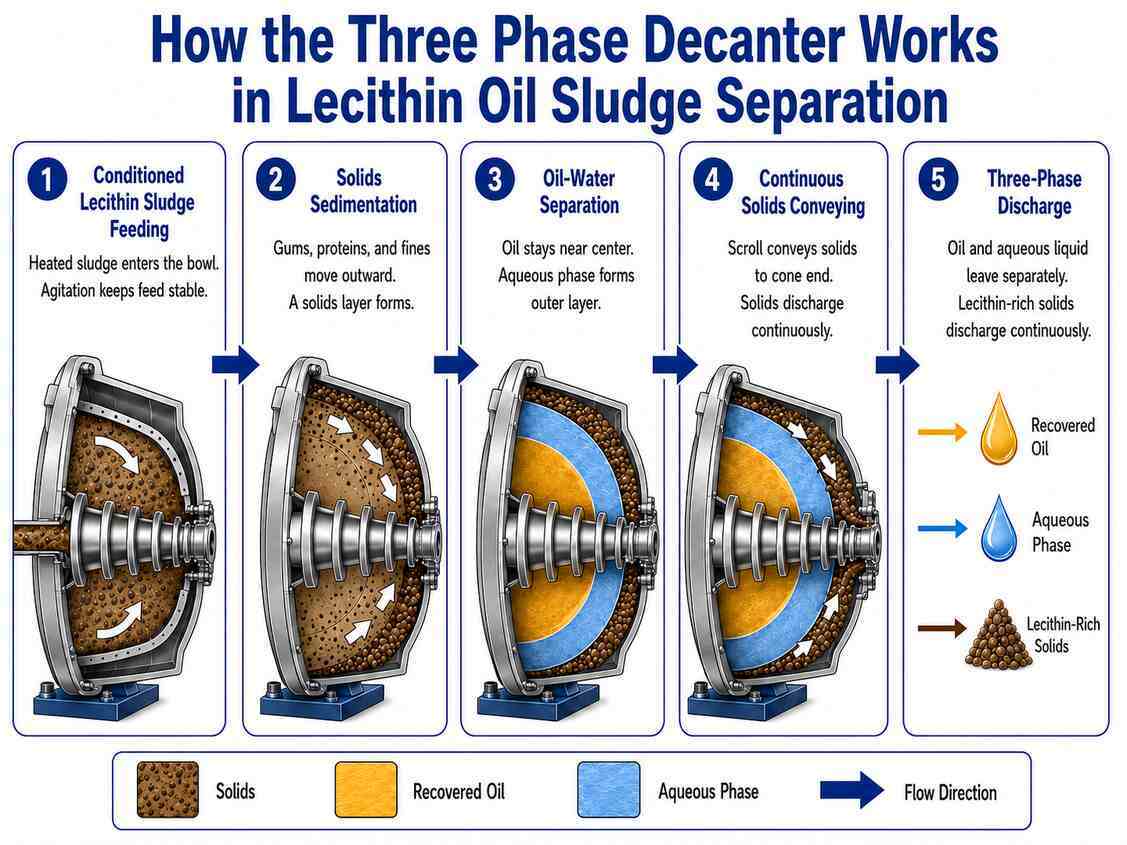
| Model | Diameter (mm) | Length (mm) | Length-to-diameter rate | G force | Max solid discharge (m³/h) | Weight (kg) | Dimension (L*W*H) (mm) |
|---|---|---|---|---|---|---|---|
| PDC-10 | 250 | 1000 | 4 | 4080 | 0.4 | 1000 | 2410*800*1080 |
| PDC-12 | 4200 | 1350 | 4 | 3500 | 0.6 | 1200 | 2610*800*1080 |
| PDC-12 | 4200 | 1350 | 4.5 | 3180 | 1.2 | 1800 | 3495*840*1180 |
| PDC-18 | 4000 | 1600 | 4.5 | 3180 | 1.2 | 3200 | 3497*1020*1385 |
| PDC-18 | 450 | 2150 | 4 | 2500 | 2 | 3800 | 4447*1080*1385 |
| PDC-20 | 400 | 2250 | 4.5 | 2500 | 3.5 | 4000 | 4580*1140*1470 |
| PDC-21 | 530 | 2280 | 4.3 | 2500 | 5 | 5000 | 4924*1170*1540 |
| PDC-26 | 655 | 2800 | 4.3 | 2270 | 8 | 7000 | 4300*1900*1350 |
Recovers vegetable oil retained in hydrated gums and reduces oil loss during degumming.
Produces a higher-solids lecithin stream for drying, purification, or further processing.
Controlled heating and adjustable differential speed support stable conveying of phospholipid-rich sludge.
Adjustable bowl speed, phase interface, and feed rate accommodate variations in oil, water, and phospholipid content.
Sanitary wetted parts, polished surfaces, and optional CIP support hygienic lecithin processing.
Please provide:
Yes. Feed temperature, viscosity, gum concentration, and water content should be evaluated before selection.
Yes, provided the pH, acid type, corrosion risk, and emulsion stability are confirmed.
It is usually recommended to reduce viscosity and maintain stable feeding. The temperature should match the lecithin-quality requirement.
Possibly. Moisture, phosphorus, gums, soaps, and suspended solids should be tested first.
Potentially. Oil content, phospholipid concentration, moisture, color, impurities, and food-safety requirements must be checked.
Peony welcomes cooperation with edible-oil refineries, lecithin producers, vegetable-oil processors, engineering contractors, equipment distributors, and regional agents.
We support partners with sludge testing, three-phase decanter selection, heating and conditioning design, phase-interface adjustment, CIP integration, commissioning, spare parts, and after-sales service.
Send us your lecithin sludge composition, temperature, capacity, oil-recovery target, product requirements, and downstream process. Our engineering team will recommend a suitable separation solution and provide technical support for distributor and agency cooperation.

|
 Three Phase Decanter Centrifuge for Oil-Water-Solid Separation
Three Phase Decanter Centrifuge for Palm Oil
Three Phase Decanter Centrifuge for Fish Oil
Three Phase Decanter Centrifuge for Animal Fat Rendering
Three Phase Decanter Centrifuge for Crude Oil Sludge Treatment
Three Phase Decanter Centrifuge for Used Cooking Oil Recovery
Three Phase Decanter Centrifuge for Algae Oil Recovery
Three Phase Decanter Centrifuge for Olive Oil
Three Phase Decanter Centrifuge for Soybean Oil Sludge Treatment
Three Phase Decanter Centrifuge for Lubricant Oil Sludge Treatment
Three Phase Decanter Centrifuge for Oil-Water-Solid Separation
Three Phase Decanter Centrifuge for Palm Oil
Three Phase Decanter Centrifuge for Fish Oil
Three Phase Decanter Centrifuge for Animal Fat Rendering
Three Phase Decanter Centrifuge for Crude Oil Sludge Treatment
Three Phase Decanter Centrifuge for Used Cooking Oil Recovery
Three Phase Decanter Centrifuge for Algae Oil Recovery
Three Phase Decanter Centrifuge for Olive Oil
Three Phase Decanter Centrifuge for Soybean Oil Sludge Treatment
Three Phase Decanter Centrifuge for Lubricant Oil Sludge Treatment

